FADE IN:
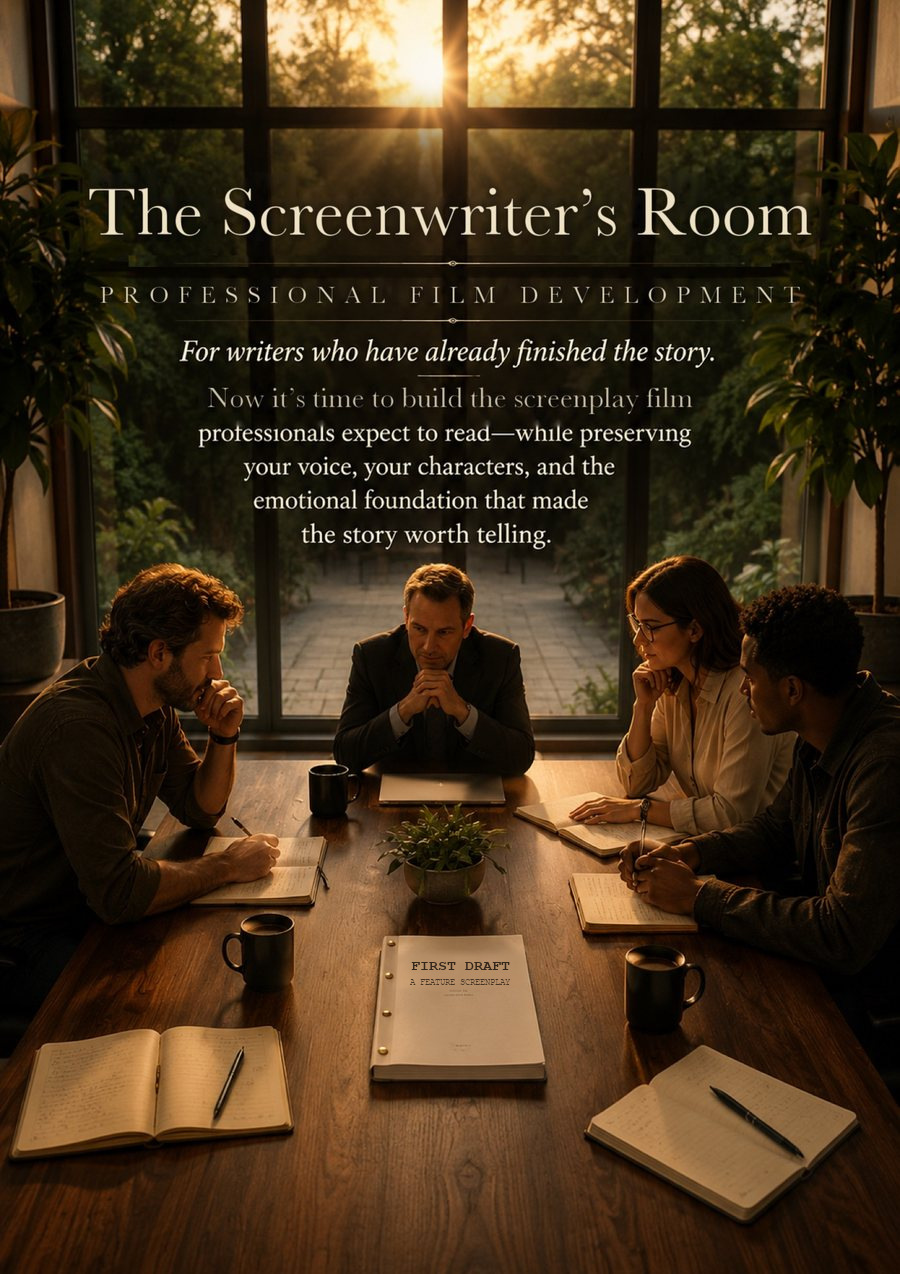
Welcome to
The Screenwriter’s Room
Your novel is written. Now see it in screen form.
Your novel told the story. Now build the first draft of the film.
We build the screenplay the way it has to be — with you, not for you. Our first pass on your novel takes some of the heavy lifting away. The first draft is yours.
Status: in build. The foundation is built and runs on our own server, and it has been tested on real chapters. Whole-novel validation and a screenwriter benchmark come before any sale; no seat opens before those gates, and nothing on this site can be ordered. Seats open after the proof.
Your novel already holds the story. TSR builds its screen form.
You wrote the novel. Now you want to see whether it can live on screen. TSR builds the first complete screenplay draft with you, in five movements.
- Your Novel You bring a finished book.
- We Understand It We read it whole, the way a screenwriter, a director, an actor and a producer would.
- You Approve the Adaptation Plan Author Gate A: nothing is written until you approve the plan, or change or veto any choice in it.
- We Build It Scene by Scene Every scene from your own pages.
- You Receive the Screenplay, the Adaptation Record, the Screen Brief and the Development Package Four documents, all yours.
FIRST DRAFT
A complete first draft
“First draft” is the honest language of screenwriting. Every produced film starts as one and goes through many more. TSR builds that first complete draft: your novel as a feature screenplay, in the format film readers expect, 90 to 120 script pages when your book supports it.
It is not a shooting script, and it is not a promise of production, representation, an option or a sale.
It is: a complete first-draft feature screenplay of your novel, in industry format, faithful to your story, with every scene traced to your pages.
It isn’t: a finished screenplay, a promise of a sale, an option, representation, a production or a placement.
You own the story. TSR takes the first adaptation pass.
Adapting a novel means making a screenwriter’s choices. TSR makes them, openly, and shows you each one.
TSR adapts your novel the way a screenwriter would, and shows you every choice before a page is written.
Before we write, you’ll see the adaptation plan: the structure, what’s cut, what’s combined, and any scene the film needs that your book doesn’t have. You approve it, or change anything in your own words.
What you must keep, and the meaning of your ending, never change without your yes.
TSR decides what an adapting screenwriter decides:
- whose film it is, and its act and sequence structure;
- what is cut, compressed, combined and reordered;
- which moments your book tells that the film must show, and the bridge scenes your book never wrote;
- the opening and final images;
- how thought and feeling become picture and sound.
Every choice comes with its reason and the pages it comes from. Every scene traces to your pages.
We may combine material when the same story purpose can be carried more efficiently, and every combination is shown to you in the Adaptation Record to keep or undo.
Before we write the screenplay
We work out, from your pages: whose story this is; what the protagonist wants; what the story means; the question that carries an audience to the end; what must remain; and what can compress.
Then you see the adaptation plan first — the conversation an author would want to have with an adapter. That moment is Author Gate A. Nothing is written before it.
What you receive
1 · The Screenplay
A PDF reading copy and an editable .docx working copy. The screenplay itself belongs to you.
2 · The Adaptation Record
This is where TSR shows its work: every scene with the pages it came from, every cut and combination, every line written for the screen, every choice from your plan — each one yours to keep, change or remove.
3 · The Screen Brief
What already plays, what deserves attention first, and where a human screenwriter, producer or director could take it further. We believe writers deserve that honesty.
4 · The Development Package
The kit for the next draft: a treatment, the act and sequence map with page numbers, character breakdowns written for casting, the motif ledger, and the look and scale of the film.
Your Adaptation Plan, before a page is written
The plan is written in plain words, not screenwriting terms: the story as we read it, the structure, the film beat by beat, every cut and combination, every scene the film needs that your book doesn’t have — with a page or two showing how it would play — and the first and last images.
You approve the plan as a whole, or change or veto any single choice in your own words. Every decision is signed and dated. What you veto never reaches the screenplay; what you change follows your words.
- Approve
- Change
- Veto
- Reopen
The pause at Author Gate A, while you read and rule on your Adaptation Plan, counts as your time, not the room’s.
Why we call it a first draft
Because that is what it is, and because the word is a strength. A complete first draft is the hardest page count in film: the structure found, the scenes built, the dialogue on its feet. What comes after — producers’ notes, a director’s needs, rewrites for a budget or a cast — happens in the hands of people. TSR gives you the draft that conversation starts from.
Built for the author who already did the hard part
You finished a novel. The characters, the world and the ending are already yours. TSR is for the author who wants to see that story in the language of the screen without handing the story to someone else.
Seats and price
Three free, controlled beta conversions come first.
The price is published after the blind benchmark and the first measured conversions.
What TSR is — and what it isn’t
TSR is an adaptation room for finished novels: it builds a professional first-draft feature screenplay with you, traces every scene to your pages, and shows its work.
TSR isn’t a finished production draft, a sale, an agent, a producer, or a substitute for the people who take a draft further. It does not adapt television; that belongs to the sister room, The Showrunner’s Room.
Before you begin
- A finished novel.
- A .docx, or a PDF whose text can be selected (not a scan).
- An English-language manuscript.
- About 50,000 to 120,000 words.
- A feature film as the result. Television belongs to The Showrunner’s Room.
- You must own or control the screen rights, or the novel must be your own unpublished work.
Nothing is collected on this page.